
Among the Sensex firms, Tech Mahindra, Wipro, Infosys, Tata Consultancy Services, HCL Technologies, Larsen & Toubro, ITC, Sun Pharma, NTPC and Titan were the major gainers. Nestle, Axis Bank, Tata Motors, ICICI Bank, HDFC Bank and Bharti Airtel were the laggards.

FIIs hold as much as 27 per cent in the over $1.6 trillion Sensex market capitalisation as of the September quarter, which is at a historic high.

Indian markets rose 19 per cent in the first half of this financial year, the best performance by any market during this period, globally.

It has so far managed to raise only Rs 1,700 crore (Rs 17 billion), by divesting a 5% stake in Steel Authority of India.

'The risk is in not being invested and missing out on an upmove.'

Announcement of macroeconmic data such as industrial production and inflation, the US Federal Reserve's interest rate decision along with trends in global equities would dictate movement in the stock market this week, analysts said. Besides, foreign fund trading activity would also guide the trends in equities. "All eyes are now on the US Fed policy outcome for cues, which is scheduled on June 14. In the following sessions, the European Central Bank (ECB) and Bank of Japan (BoJ) will also announce their policy decisions.

The sharp rally in the markets thus far in fiscal 2023-24 (FY24) has left analysts struggling to find investment-worthy themes. The S&P BSE Sensex has surged nearly 7 per cent thus far in FY24 and hit a fresh 52-week high of 63,601.71 levels on June 22, mostly led by foreign institutional (FII) flows. "The Indian market has seen a broad rally in the past few months but headline indices have seen more modest performance. "We are not very clear about the reasons for the rally and the divergent performance and struggle to find ideas in the consumption, investment and outsourcing sectors after the sharp run-up in several of our favored sectors and stocks in the past two months," wrote Sanjeev Prasad, co-head, Kotak Institutional Equities, in a recent co-authored note with Anindya Bhowmik and Sunita Baldawa.

'Investors should continue to invest because you are looking at the long-term; in the next four to five years, we are bound to outperform (the rest of the world equity markets).'

Mahesh Nandurkar, executive director and India Strategist at CLSA, talks to Puneet Wadhwa ahead of their 21st India Forum on his interpretation of how the markets have played out over the past few months, the road ahead, and his sector preferences in this backdrop.
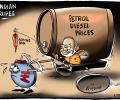
Even as rising crude oil prices, trade war fears and a sliding rupee cast a shadow on market sentiment, Nischal Maheshwari, chief executive officer for institutional equities and advisory at Centrum Broking, tells Puneet Wadhwa that in the next one year, the outcome of the 2019 general election is a bigger challenge for the market.

Among the Sensex firms, Tata Motors jumped over 3 per cent. Tech Mahindra, Infosys, HCL Technologies, Axis Bank, Mahindra & Mahindra, ICICI Bank, UltraTech Cement and Kotak Mahindra Bank were the other major gainers. NTPC, Asian Paints, Titan and Power Grid were among the laggards.

The bull run in the Indian equity markets is intact, said analysts at Morgan Stanley in a recent note. They expect the S&P BSE Sensex to hit 80,000 levels by December 2023 in their bull-case scenario, to which they have assigned a 30 per cent probability. From the current level, this translates into an upside of nearly 29 per cent.

Overseas investors witnessed net inflow of Rs 24,563 cr in Feb

'India seems to be on a relatively better wicket compared to other emerging markets.'

The domestic stock market may face volatility amid the monthly derivatives expiry scheduled this week, while investors would mainly await the outcome of RBI's interest rate decision on Friday, said analysts. Global market movement would also continue to drive sentiment amid a bearish trend recently following rate hikes by the US Federal Reserve and other central banks. The Reserve Bank of India (RBI) may take cues from its global counterparts to raise interest rate for the fourth time in a row to control inflation.

'Valuations of midcaps and smallcaps have reached very high levels, and hence to that extent leave little margin of safety.'

Returns turn negative as FIIs turn sellers of equities in October.

Motilal Oswal, chairman and managing director, Motilal Oswal Financial Services, tells Puneet Wadhwa that with Moody's upgrading India's sovereign rating and earnings growth coming back, the country will remain a hot destination for foreign investors.

With investments by foreign investors expected to rise in the coming months, the total overseas fund flow this year could well surpass the highest ever figure recorded in 2007, when India attracted a whopping Rs 70,000 crore (Rs 700 billion).

The rupee rose by 12 paise to close at 79.78 against the US dollar on Monday due to a weak dollar in overseas markets and an improved appetite for riskier assets. Stronger regional currencies also supported the rupee sentiment ahead of the US Fed policy decision on Wednesday. Weak domestic equities and FII outflows, however, capped sharp gains. At the inter-bank forex market, the local unit opened at 79.86 against the greenback and moved in a range of 79.70 to 79.87 in the day trade.

'Macro headwinds are rising for Indian equities in the form of rising commodity prices, especially oil, depreciating rupee, fiscal challenges, election-related uncertainty and upside risks to inflation'
The derivatives expiry on Thursday is also expected to add to the volatility.

In 2015, foreign investors slowed net buying of Indian equities.

'If you see another 1000-point correction, people may start panicking.'

From the Sensex pack, Larsen & Toubro jumped 4.26 per cent to emerge as the biggest gainer, followed by IndusInd Bank, Tech Mahindra, State Bank of India, HCL Technologies, Power Grid, NTPC, Axis Bank, Kotak Mahindra Bank, HDFC Bank and Wipro. Mahindra & Mahindra, Infosys, UltraTech Cement and Hindustan Unilever were the major laggards.
.jpg)
The broader consensus was that the Fed would cut the monthly stimulus of $85 billion by $10-15 billion.

However, volatility is likely to be on the rise, said Benjamin Yeo, MD & CIO (Asia & Middle-East) for Wealth & Investment Management, Barclays.
From the 30-share pack, Titan, Tech Mahindra, Maruti Suzuki India, Wipro, Nestle India, TCS, Larsen & Toubro, HCL Technologies, Tata Steel and HDFC Bank were among the major laggards. NSE Nifty declined 69.75 points to settle at 17,153.

Benchmark stock indices Sensex and Nifty closed with losses in highly volatile trade on Thursday as banking and financial stocks retreated amid a weak trend in global equity markets. The 30-share BSE Sensex declined 89.14 points or 0.15 per cent to settle at 57,595.68. During the day, it touched a low of 57,138.51 and a high of 57,827.99. The broader NSE Nifty dipped 22.90 points or 0.13 per cent to settle at 17,222.75.

With the euphoria over the National Democratic Alliance's victory in the stock market continuing, the rupee is likely to touch 57 to the dollar soon.

Investor sentiment got a big push after Brent crude, the international benchmark, dropped below the $73-mark to quote at a seven-month low of $72.65

Analysts attribute the surge to a host of factors, particularly the interest shown by the retail investors in these two market segments.

Kotak Bank was the top gainer in the Sensex pack, ending 4.31 per cent higher. PowerGrid, TCS, ICICI Bank, SBI, HCL Tech, NTPC, Infosys, Bajaj Finance, HDFC duo, ONGC, Vedanta and IndusInd Bank too rose up to 2.84 per cent.

With the markets scaling new highs, as many as 43 stocks from the Nifty50 index and 27 of the 30 scrips that are part of the S&P BSE Sensex are trading above their respective 200-day moving average (DMA). The 200-DMA is seen as one of the most relevant trend indicators by investors and traders, who believe that stocks and indices trading above this level possess strength and are likely to rally in the short to medium term, while the ones trading below this level are viewed as bearish and expected to see a sell-off. Wipro, UPL, Kotak Mahindra Bank, Hindalco, Infosys, Cipla, and Adani Enterprises are the only stocks from the Nifty50 pack that are still below their respective 200-DMA, the exchange data suggests.

The Budget has to provide for capex on roads, railways, defence and other infrastructure sectors.

Dalal Street investors became richer by more than Rs 16.36 lakh crore this year as the equity market scaled new highs despite persistent geopolitical uncertainties and inflation worries. Analysts attributed better macroeconomic fundamentals, the confidence of retail investors and foreign investors investing again in the domestic equities towards the latter half of 2022 as the key factors that led to the outperformance of the Indian market in comparison to many other stock markets worldwide. During the initial part of the year, markets were jolted by the Russia-Ukraine war.

While a coordinated aggressive monetary easing from the central banks is most likely to offer some respite in the near-term, it is unlikely to improve the sentiments.

But much depends on govt action & global economy; Sensex gains in 2070 the biggest in five years

Dilip Bhat, joint managing director of the Prabhudas Lilladher group, a financial products agency, talks to Business Standard about the market rally ahead of the elections.

Nobutaka Kitajima, chief investment officer -- equity, LIC Nomura Mutual Fund, tells Business Standard the reaction to the Fed's statements has been overdone and the current downturn has punished certain stocks much more than their inherent economic worth and business potential.
